
The Isolated Ecosystem
Joshua M. Smith, MSc.
Introduction
As the grueling global football calendar concludes and squads disperse for their vital summer recovery, performance departments execute highly sophisticated biological audits to rebuild their athletes. However, within this complex matrix of applied sports science, one specific cohort requires an entirely distinct physiological and biomechanical approach. The goalkeeper exists in a completely isolated ecosystem on the pitch. While modern outfield players are essentially highly evolved endurance athletes constantly managing cardiovascular exhaustion and linear soft tissue fatigue, the elite goalkeeper is a pure anaerobic power athlete. Their matchday reality is defined not by total distance covered or high-speed running volume, but by explosive lateral bounds, decelerations, immediate cognitive processing, and thousands of repetitive blunt force impacts with the turf. Providing a goalkeeper with a standard off-season cardiovascular running program is a fundamental clinical failure that completely ignores their unique biological profile. The physiological toll of diving, catching, and reacting creates a highly specific allostatic load characterized by upper extremity micro trauma, severe pelvic asymmetry, and central nervous system burnout.
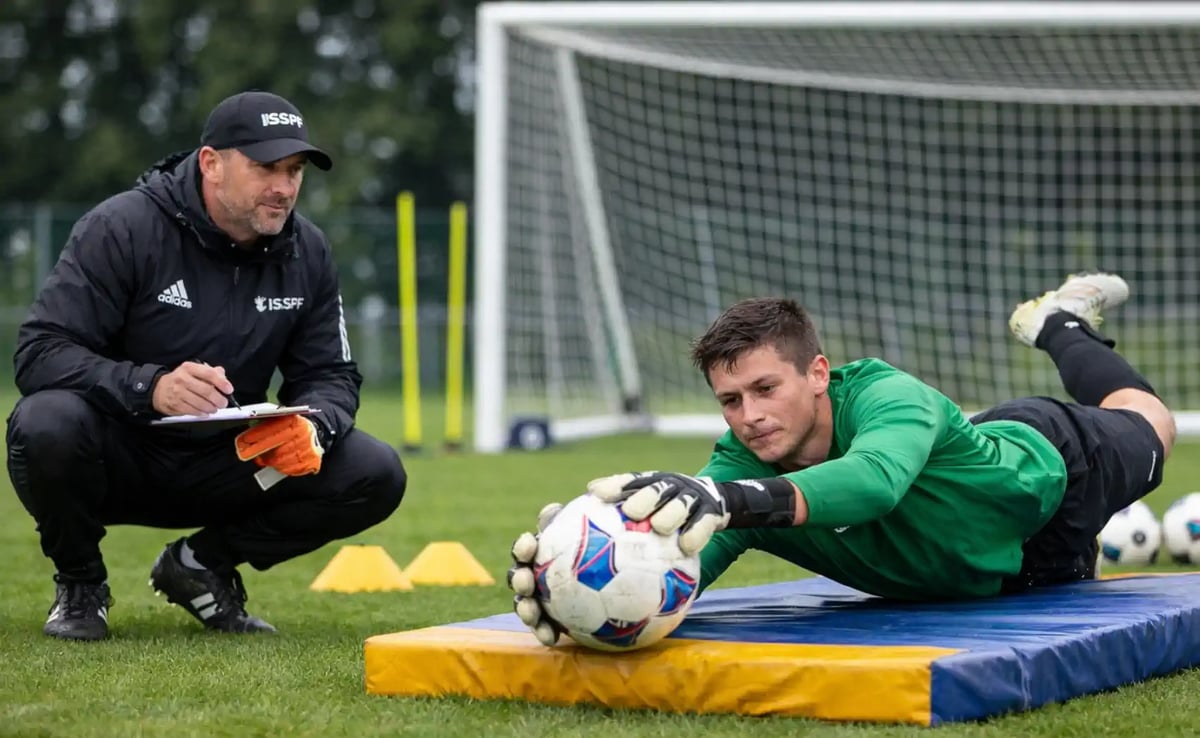
A goalkeeper spends ten months operating in a state of hyper vigilance. Their sympathetic nervous system is constantly primed for immediate and explosive action, leading to severe adrenal fatigue by the time the season reaches its climax in May. The psychological burden of being the final line of defense means these athletes operate with chronically elevated cortisol levels, as every physical action they take carries the weight of potential failure. Furthermore, the modern proliferation of highly aggressive hybrid grass surfaces has dramatically increased the coefficient of friction on the pitch. When a goalkeeper lands and slides across these reinforced synthetic fibers, the unnatural friction aggressively grips their joints, transferring immense shearing forces directly into the hips, shoulders, and lower lumbar spine. To successfully rebuild a goalkeeper for the subsequent campaign, elite medical departments must discard the traditional outfield metrics and periodization models entirely. Instead, they must deploy a highly specialized diagnostic blueprint tailored strictly to the unique biomechanics of flight. By constructing an individualized off-season curriculum that prioritizes structural armoring, joint decompression, and the restoration of explosive neuromuscular firing rates, sports scientists ensure this highly specialized asset is protected against the unique traumas of their position.
The Biomechanics of Flight
The diagnostic process for a goalkeeper completely reorients the clinical focus away from the standard lower limb cardiovascular assessments utilized for midfielders and forwards. The defining physical characteristic of elite goalkeeping is extreme lateral dominance. Over the course of a ten-month competitive season, a goalkeeper will subconsciously develop a favored side for diving and a dominant plant leg for maximum power generation. This repetitive action creates a massive structural asymmetry over time. The dominant push-off leg develops hyper stiffness in the patellar tendon and immense muscular hypertrophy in the quadriceps and gluteal complexes. Conversely, the contralateral leg suffers a relative detraining effect, losing its elastic recoil and eccentric strength because it is not subjected to the same absolute peak forces daily. Furthermore, the constant act of landing heavily on the favored side drives immense compressive forces through the greater trochanter of the femur and the acromioclavicular joint of the shoulder. This repetitive blunt force trauma leads to silent and chronic bone stress reactions, bursitis, and labral fraying that a player will often hide or completely ignore during the competitive season. To uncover these hidden structural deficits, sports scientists deploy a highly targeted battery of goalkeeper-specific biomechanical tests within forty-eight hours of the final match.
The biological audit begins with an advanced morphological assessment using dual-energy X-ray absorptiometry. For a goalkeeper, the medical staff actively analyzes the bone mineral density of the shoulder girdle and the pelvic ring to identify any micro porosities caused by impact trauma. This is often paired with highly sensitive magnetic resonance imaging of the dominant shoulder to assess the integrity of the glenoid labrum and the articular cartilage, which are frequently degraded by the repetitive shock of landing from full extension saves. Following the structural scans, the athlete undergoes rigorous hematological screening. Because goalkeepers rely so heavily on fast-twitch muscle fiber recruitment, maintaining an optimal internal cellular environment is paramount. Sports scientists measure the Omega-3 index to assess cellular membrane health and test for specific inflammatory biomarkers like high-sensitivity C-reactive protein. If systemic inflammation is left unchecked during the summer, the athlete will be entirely unable to synthesize new muscle tissue. Once the biochemical baseline is established, the athlete moves into advanced biomechanical testing to measure true mechanical output. The medical staff utilizes a isokinetic dynamometer to measure the internal and external rotational torque of the rotator cuff. A compromised or fatigued rotator cuff is the absolute leading precursor to catastrophic shoulder dislocations.
Subsequently, the athlete undergoes advanced lateral force plate testing. The goalkeeper is instructed to perform maximal single-leg lateral bounds while the dual-axis plates measure their precise rate of force development and peak ground reaction forces. This diagnostic tool instantly quantifies the exact percentage of power discrepancy between the left and right hip complexes. To supplement the force plates, modern performance departments now utilize three-dimensional optical motion capture systems. By placing reflective markers on the goalkeeper’s major joints and recording them with high-speed cameras during simulated diving protocols, sports scientists can perfectly measure the athlete’s exact kinematic sequence. This reveals if a fatigued goalkeeper is dropping their hips prematurely or altering their spinal alignment during takeoff to compensate for a hidden groin injury. Additionally, specialized isometric rigs can be deployed to measure the adductor-to-abductor ratio. Given the extreme width of a goalkeeper’s ready stance and the violent nature of split-saves, a severe imbalance in the groin musculature is a primary indicator of impending osteitis pubis or severe adductor avulsions. The cognitive load of the position is also subjected to rigorous testing. Sports scientists measure the vestibulo-ocular reflex to ensure the athlete’s inner ear and visual tracking systems are perfectly synchronized, as the constant rotational forces of diving can heavily disrupt spatial awareness and balance. Advanced neuro-cognitive software can also be used to test multiple object tracking and reaction time degradation. A fatigued goalkeeper will demonstrate a fractional delay in visual processing, which translates to critical milliseconds lost when reacting to a deflected shot.
The translation of this highly specialized diagnostic data into the goalkeeper’s individualized off-season curriculum is executed through a strictly periodized reconstruction model. The initial active regeneration phase spans the first two weeks of the off-season and is dedicated entirely to joint decompression, systemic offloading, and autonomic nervous system resetting. Unlike outfield players who might utilize light jogging to flush metabolic waste, goalkeepers are strictly prohibited from experiencing any ground-impact forces during this specific period. Performance coaches prescribe deep-water aquatic therapy and advanced spinal mobility flows. The hydrostatic pressure of the pool environment assists in reducing localized edema in the battered joints while allowing the severely compressed spinal discs, inflamed hip bursae, and damaged shoulder capsules to finally decompress and heal without introducing any new mechanical stress. Nutritional interventions during this first phase are heavily biased toward daily doses of hydrolyzed collagen, tart cherry juice, and Omega-3 fatty acids. This specific biochemical combination acts to actively repair degraded articular cartilage and extinguish the localized joint inflammation that accumulates over a grueling season. Sleep architecture is heavily monitored via wearable technology to ensure the athlete is maximizing slow-wave sleep, which is the exact phase where the pituitary gland releases the human growth hormone necessary for complete cellular repair.
As the autonomic nervous system stabilizes and the athlete exits the state of chronic systemic fatigue, the program shifts into the structural remediation and tissue hypertrophy phase. This is the critical and highly clinical window where the biomechanical asymmetries identified during the end-of-season audit are corrected. If the lateral force plates revealed a severe power deficit in the non-dominant push-off leg, the athlete’s daily matrix becomes heavily weighted toward single-leg eccentric overloading of that specific hip complex. Sports scientists utilize advanced flywheel resistance technology to achieve this specific adaptation. By relying on inertia rather than gravity, flywheels force the gluteal and adductor fascicles to physically lengthen while absorbing massive force, structurally hardening the pelvic girdle and fully correcting the lateral imbalance. Simultaneously, upper body programming focuses on isometric holds and heavy slow resistance training for the rotator cuff and scapular stabilizers. By utilizing highly controlled and low-velocity mechanical tension, the medical staff forces the cellular mechanotransduction process to synthesize new and highly organized collagen networks within the shoulder capsule. For goalkeepers struggling with chronic joint pain who cannot tolerate heavy weightlifting, blood flow restriction training is deployed. Pneumatic cuffs are applied to the upper arms to temporarily restrict venous blood return, creating a hypoxic environment in the muscle tissue. This advanced technique recruits the crucial fast-twitch muscle fibers and triggers a massive hypertrophic hormonal response utilizing only twenty percent of the athlete’s one-rep maximum weight, thereby saving the joints from unnecessary compressive stress. This process effectively creates a dense suit of biological armor around the vulnerable joints, preparing them to absorb the blunt force trauma of the upcoming pre-season.
The final phase of the goalkeeper’s off-season program serves as the high-velocity and neurologically demanding bridge into formal pre-season training. Having successfully healed the joints and corrected the power asymmetries, the physical conditioning staff must now reignite the central nervous system and prime the specific metabolic pathways utilized in goal. The slow and isolated structural exercises of the previous phase are replaced by explosive and multidirectional plyometrics. Crucially, these plyometrics are heavily biased toward lateral and diagonal force production rather than purely vertical jumping, perfectly mimicking the exact kinematic demands of elite shot-stopping. The metabolic conditioning entirely targets the phosphocreatine energy system, utilizing ultra-short maximal sprints of no more than five to ten meters followed by complete and total recovery. This ensures the correct energy pathways are biologically optimized without flooding the body with unnecessary lactic acid. In addition to this, sports psychologists and performance coaches should look to integrate advanced cognitive priming protocols into these physical movements. Strobe-light visual occlusion glasses and reactive light pods are one some tools that can be used while executing their lateral bounds. The strobe effect momentarily removes visual data, forcing the brain to rapidly process chaotic and incomplete visual stimuli to execute complex motor commands in milliseconds. This actively drills the vestibular system and fully restores the athlete’s hand-eye coordination, spatial awareness, and neuromuscular latency to elite levels. By remotely tracking this final phase through wearable biometric technology, the performance director ensures that the goalkeeper returns to the club facility completely devoid of their previous asymmetries and cross the threshold of the training ground possessing absolute structural integrity and boasting a central nervous system that is violently primed for the extreme demands of the modern game.
Conclusion
The elite goalkeeper occupies a truly unique biological and biomechanical space within the ecosystem of modern global football. Attempting to rehabilitate and prepare a goalkeeper using the standardized cardiovascular metrics of outfield players is a recipe for structural failure, chronic joint pain, and immediate athletic decline. The implementation of highly specific and position-tailored end-of-season testing removes the dangerous element of guesswork from their management, exposing the silent joint trauma and lateral asymmetries generated by thousands of explosive dives over a long campaign.
By utilizing this precise diagnostic data to construct a bespoke and asynchronous off-season program, elite performance departments ensure that the vital summer months are utilized correctly. They transform the off-season into a highly specialized clinical laboratory for joint decompression, asymmetric correction, and neurological re-ignition. Ultimately, this level of extreme clinical precision guarantees that the club’s final line of defense returns to the pitch possessing the absolute structural armor and explosive reaction speed required to dominate the penalty area in the grueling season ahead.

Course 1 Overview
This course equips coaches with the latest training methods, tactics, and strategies to effectively develop and mentor youth goalkeepers. Learn how to design and apply training programs tailored to long-term athlete development (LTAD), while also understanding the unique demands of goalkeeper development within a team setting.
Explore essential topics like skill acquisition, managing pressure, and the role of nutrition in youth goalkeeper performance. With a deep dive into elite academy training methods, this course will give you the tools to enhance your players’ performance, foster their growth, and prepare them for the demands of top-level goalkeeping.
This professional-level course is designed to ensure you’re ready to guide youth goalkeepers through every phase of their development and maximize their potential.
Course 2 Overview
Learn how to prepare goalkeepers for the specific competitive demands of modern soccer, improve efficiency through soccer-specific movement preparation, and build a goalkeeper-specific training and game model. Explore advanced topics like decision-making, coping with anxiety, and the resilience needed to perform at the highest level.
With an emphasis on practical coaching strategies, this course equips you with the tools to maximize goalkeeper performance in training sessions and ensure they’re ready for the pressures of match day.